Posts
Heard it from a friend, who heard it from a friend, who....
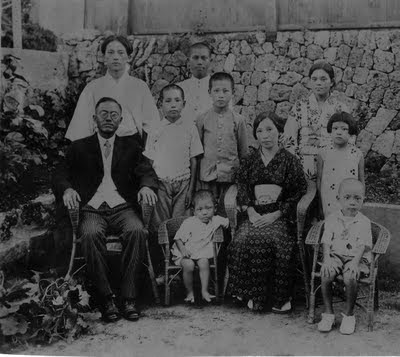
Today's project involves the family in this picture. We don't know who they are. This photo, as well as many others, are all glued to construction paper pages inside an old leather-bound album we received today from a friend. She got it from her father, a farm boy from Texas who fought in Okinawa the winter of 1945 against the Japanese. How exactly he got it, we aren't sure. Someone, probably another young man from another side of the planet, was carrying this album with him as the world was falling apart. There's very little writing in it. Not enough to provide any sort of clue to the people or even the specific locales. School pictures, family photos, pictures on the beach, but oddly nothing really definitive. No signs, landmarks. A few cryptic notes. We're assuming, from what little we can piece together, that the mystery owner was probably from Okinawa, and not just stationed there. Our niece, who lives on one of the islands of Okinawa (of which there are hund...
Social Postits

Well this was cool. I was researching the "Nook" a bit more (an e-reader from Barnes and Noble.) What I was curious about was whether it supported PDFs and how. That was a major limitation of the Kindle. I have about, oh 2000+ PDF books I'd like to move over. In the product comparisons I noticed the little highlight indicator of the software I discussed below ( diigo ) which allows people to put "postits" on a web site and share them with friends or the world. So I hovered the mouse over those and got a pop-out of some good information about that particular detail and how it was implemented that wasn't provided or approved by the official site. In fact, they have no clue those postits are even there. Now here is this whole other layer of the web superimposed on the first layer. One of annotation and commentary that can span the public at large, related groups and affiliations or just a single user, making a note for themselves about something when they ...
Growing a Book
I've been mucking around with hubpages. It's in the same category as squidoo, designed to publish single topics in a big ecosystem of topics. A nice approach for people who don't want to maintain dedicated web sites, or want to supplement that activity, with pocket money coming in from pay per click ad revenue and other options. But there is another application for these systems, I'll call it "The Incremental Book." The more successful publishers at these sites usually have several islands of interest. A particular topic or category that they explore with a number of independent articles (lens, hubs, pages,etc ) that all referencing each other in a mesh of links. This is good marketing. Google likes pages that have links pointing to them and this "backlinking" is a strategy for pushing a page up in the search results of google, assuming you've picked good keywords/phrases and your article is organized well around that single focus. Kind of like w...
Maybe the Dingo Ate your baby?
That was such a weird line from Elaine on Seinfield . One of those phrases that stick in your head and you have to catch yourself from blurting out in inappropriate social contexts. Or not. Continuing the theme of posts about useful tools ---for those writing and researching on the internet, I've been playing with this puppy recently: http://www.diigo.com And it's pretty impressive. You can put "sticky" notes on any web page (that just you, or others you want to share with, can see) You can highlight important parts of a page, the highlighted text is saved in your bookmarks on diigo which you can tag, search, etc. You can search across all your bookmarks, tags, etc. Stuff is saved when you bookmark, so if the page goes away, you still have the information You can "publish" any of your tags to blogs as a feeds or post directly as an article. All this can be private, just for you as a research tool, but it's also cool that you can collaborate with a group...
Finding Images You Can Use

Photo by Randy Son of Robert's. If you are looking for good images to use on your web sites, blogs, squidoo lens, etc. here is a secret weapon. Flickr has a number (i.e. > 16 million) images that users have uploaded under the Creative Commons Attribution License . This license permits you to use the photo on personal or commercial sites, crop it, tweak it, etc. as long as you give credit to the owner. That's the first part of the secret. The second part is how to search for just the images with this license, and find good ones in the mix. This link goes directly to the search box on Flickr for Attribution only licenses . Enter any search term and you'll get a list of pretty mediocre shots. So the next step... above the list of thumbnails returned by the search, you'll see the default sort is "Most Relevant." Click on "Interesting" instead and you should have some pretty images that have gone through a certain amount of "crowd sourcing" ...
The Case of the Flying Boy
A strange case here in Colorado. It starts with a rather unusual family from Fort Collins, one Richard and Mayumi Heene. Richard is a tinkering home scientist type, was once a meteorologist (aka weatherman.) They have three boys. The family chases storms for fun and works on science projects in their backyard together. They were once featured in ABC's Wife-swap show. As our story begins, there is a large mylar balloon, 20 feet in diameter and 5 feet high, filled with helium moored to the side of their house. A box is attached to the balloon for equipment, like the basket on a hot air balloon, but at the moment it is empty. Richard and Mayumi are in the house, the boys are playing outside. Suddenly, an older brother comes running in the house shouting that his little brother, aptly named "Falcon", who is 6 years old, had released the balloon and was inside the box. The balloon was designed to hover about 20 feet above the ground. They ran out to see it disappearing into th...